Membranes And Catalysts Beyond Economic and Technological Hurdles

In the process industry, downstream processes are the steps with the highest consumption of energy and resources in industrial operations. Moreover, the integration of new processes often requires a large portion of Capital Expenditures (CAPEX) and Operating Expenditures (OPEX). To significantly enhance the competitiveness of the European process industry and to contribute to Europe’s goal of a clean and liveable environment, it is highly desirable to have a very broadly applicable concept for an efficient integration of downstream operations in the overall process chain.
Impact
The MACBETH consortium provides a breakthrough technology by combining catalytic synthesis with the corresponding separation units in a single highly efficient catalytic membrane reactor (CMR).
This disruptive technology can reduce greenhouse gas emissions of large volume industrial process by up to 35 %. Additionally, resource and energy efficiency will be increased by up to 70%. The revolutionary new reactor design will not only guarantee substantially smaller and safer production plants but has also a tremendous competitive advantage since CAPEX is decreased by up to 50% and OPEX by up to 80%.
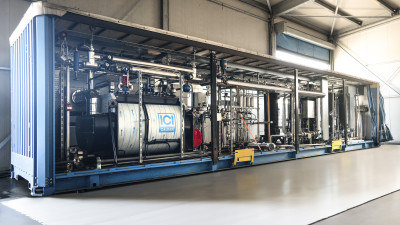
To achieve this, the MACBETH consortium combines the catalytic synthesis step with the highly efficient separation step via a tailor-made membrane. The predecessor EU funded projects ROMEO, BIONICO and CARENA and further fundamental developments have laid a strong basis by showing the proof of concept for CMRs at TRL 5. Successful pilot plants have been operated for highly relevant and large-scale processes:
- i) Hydroformylation
- ii) Hydrogen production
- iii) Propane dehydrogenation.
Michele Ongis, CTO and co-founder of Modelta B.V.: "High-tech startups are important for the growth of EU competitiveness. In public-funded projects, they are a key element to exploit the know-how developed. MACBETH, gave us the opportunity to contribute to this step up."
Key members of these consortiums have now joined forces in MACBETH to bring CMR to the level of TRL 7 and build the basis to move forward for commercialization of the three novel technologies. Moreover, within the project, Eindhoven University of Technology has created a spinoff (MODELTA) that commercializes the model solutions developed in the different lines.
More info: https://www.macbeth-project.eu/ and https://modelta.nl/.
Horizon 2020 - Industrial Leadership - Leadership in enabling and industrial technologies
Meer verhalen van Technische Universiteit Eindhoven
-
-
MACBETH: Membranes And Catalysts Beyond Economic and Technological Hurdles
Technische Universiteit Eindhoven
-